Call us now: +1(800) 123 4567
Email: oesus@support.com

Buying a portable oscilloscope involves more than comparing specifications and the initial purchase cost. An instrument may appear suitable for industrial troubleshooting, yet its long-term cost can increase through accessories, calibration, repairs, training, and downtime. Without considering these factors, maintenance teams may select equipment that places unnecessary demands on their operating budgets.
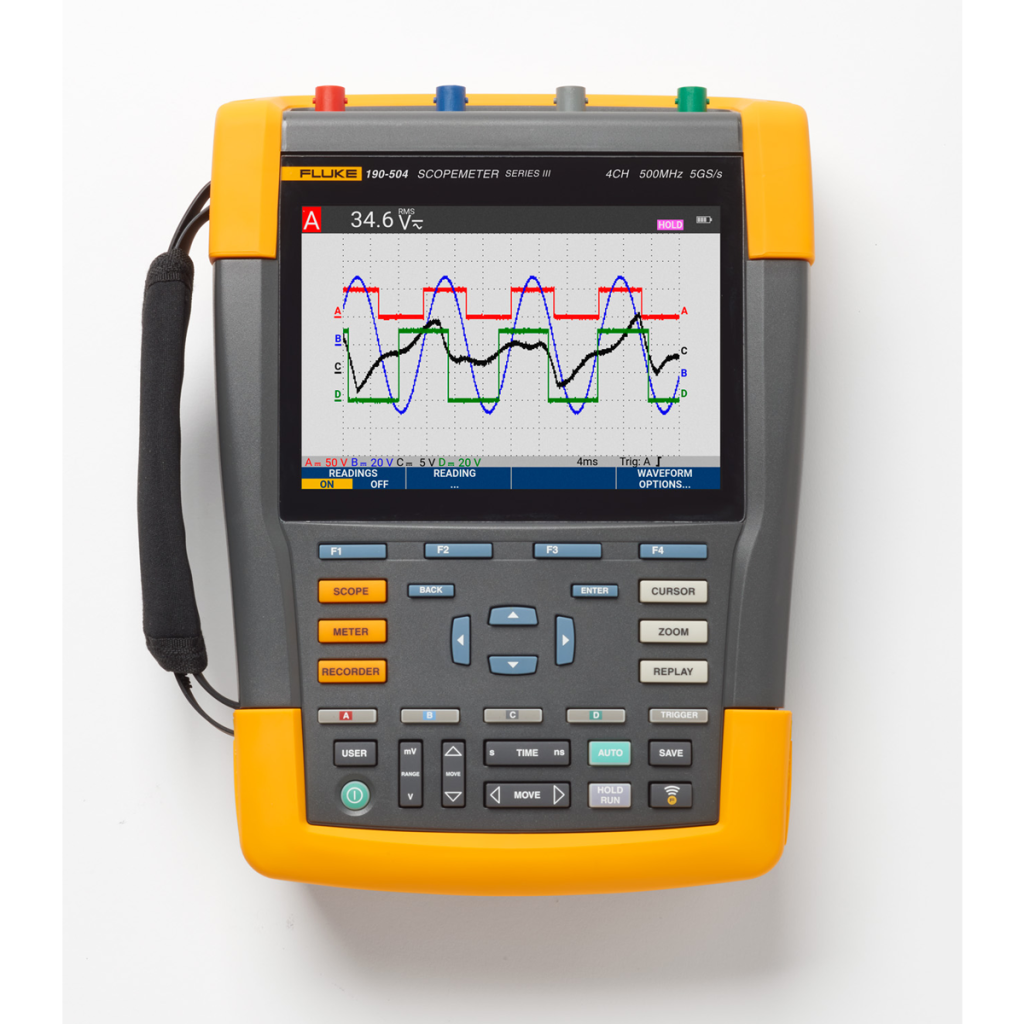
If you plan to buy a Fluke ScopeMeter, assessing its total cost of ownership (TCO) can help you make a more informed purchasing decision. TCO considers the costs associated with acquiring, operating, maintaining, and eventually replacing an instrument throughout its useful life.
The objective is not simply to choose the least expensive model. Instead, you want an instrument that meets your technical requirements while supporting reliable field diagnostics and predictable maintenance expenses. This guide explains the main cost factors, how to compare models, and how to evaluate long-term value before purchasing.
The purchase price represents only one part of an instrument’s financial impact. Depending on the model and your operating environment, additional costs may arise throughout its service life.
A useful TCO assessment considers both direct expenses and operational costs associated with using the equipment.
When comparing ScopeMeter models, consider:
Not every category applies to every purchase. For example, a team that already owns compatible accessories may need fewer additional components than a team establishing a new diagnostic capability.
Therefore, assess each model against the same assumptions. This creates a more meaningful comparison than looking at the acquisition cost alone.
A lower-cost instrument may seem attractive, but it can become an inefficient choice if it lacks the capabilities your technicians need. Conversely, purchasing a more advanced model may add expense without improving the tasks your team performs regularly.
The key is to establish minimum technical requirements before comparing the overall cost.
Identify the measurements your team performs most often. These may include checking control signals, capturing intermittent faults, examining switching behavior, or combining waveform analysis with multimeter measurements.
Then compare candidate models based on:
For example, a technician who mainly checks industrial control signals may not need every advanced acquisition feature available in a higher-tier model. However, a team investigating fast transients or complex power electronics may need additional bandwidth, specialized probes, or more capable waveform capture.
Technical suitability should be a mandatory requirement, not a benefit that a low acquisition cost can compensate for.
First eliminate models that fail essential measurement or safety requirements. Then compare the TCO of the remaining candidates.
For a structured approach to evaluating technical capabilities, review this guide to comparing Fluke ScopeMeter models for field diagnostics.
Accessories and ongoing services can influence the long-term cost of a ScopeMeter. Consequently, verify what the supplier includes and what your team must arrange separately.
Start with the equipment required for your actual measurement tasks. Depending on the application, you may need compatible probes, test leads, adapters, current measurement accessories, or protective carrying equipment.
Check the exact model numbers and ratings. An inexpensive accessory that does not meet your measurement or safety requirements does not represent a useful saving.
Also distinguish between standard accessories and optional components. Two product quotations may appear similar while covering different configurations.
Calibration expenses depend on the instrument, service provider, required scope, and your organization’s procedures. Some applications may require documented calibration at defined intervals, while others may follow a risk-based equipment management approach.
Before purchasing, ask what calibration services are available, what documentation they provide, and whether the supplier coordinates repairs or recalibration.
Avoid assuming that every new instrument includes a calibration certificate or that every model requires the same service schedule. Confirm the applicable terms and requirements.
You can estimate these recurring expenses using a simple calculation:
Estimated ownership cost = acquisition cost + accessories + calibration and maintenance + training and software + downtime impact + replacement-related costs.
Use a consistent period, such as five years, when comparing candidate models. Include only relevant expenses and document your assumptions.
For example, if one model requires additional accessories at the outset but another requires a specialized accessory later, account for those expenses in the appropriate year. This produces a more realistic comparison than treating the first quotation as the complete cost.
The financial impact of an instrument extends beyond invoices. When technicians cannot access the diagnostic equipment they need, troubleshooting may take longer or require alternative arrangements.
However, downtime estimates should reflect your actual operating conditions rather than speculative savings claims.
Ask how your team would respond if a ScopeMeter needed repair or recalibration. Would another compatible instrument be available? Could technicians continue essential work with different equipment? Would the absence of the instrument delay maintenance or require external support?
Relevant factors include:
For instance, a plant maintenance department that shares one portable oscilloscope among several technicians may experience scheduling conflicts during busy maintenance periods. An additional instrument could improve availability, but its value depends on actual utilization and the cost of alternative arrangements.
A user-friendly instrument may reduce time spent navigating menus or configuring measurements. Likewise, suitable waveform storage may simplify reporting and help technicians share evidence with engineering colleagues.
Nevertheless, do not assign financial savings without supporting evidence. If you estimate productivity benefits, base them on realistic task frequency, observed time requirements, and the cost of technician time.
A practical TCO assessment should distinguish measurable expenses from potential benefits. This keeps the purchasing decision grounded in operational evidence.
Warranty and service arrangements can influence the cost and predictability of ownership. Two models with similar technical capabilities may have different support options, repair processes, or accessory availability.
Before ordering, establish what the supplier and manufacturer provide.
Review these points for each candidate:
Do not assume that a warranty covers routine calibration, accidental damage, or every repair. Read the relevant terms and ask the supplier to clarify any important exclusions.
Also consider whether the instrument can support your expected workload over several years. Product specifications, accessory availability, and service arrangements may affect how easily the equipment fits your maintenance process.
For a deeper review of lifecycle support, consult how to evaluate calibration instrument supplier service options.
Finally, consider replacement planning. If the instrument becomes unsuitable for a future application, your organization may need to upgrade or acquire additional equipment. You do not need to predict every future requirement, but identifying likely changes can improve the purchasing decision.
Once you understand the cost categories, compare candidate models using the same evaluation period and assumptions. This helps purchasing teams explain why a particular model offers better overall value for their application.
For each candidate, record:
Use supplier quotations, service information, internal maintenance records, and actual utilization data wherever possible. Mark uncertain figures clearly rather than presenting estimates as guaranteed expenses.
Next, compare the results alongside technical suitability. A model with a lower projected TCO may still be unsuitable if it fails a critical safety or measurement requirement.
Similarly, a model with higher ownership costs may be justified if its additional capabilities directly support essential diagnostic tasks. Document that rationale so the decision remains transparent.
Before finalizing the purchase, confirm the exact model, included accessories, warranty terms, documentation, and service arrangements in writing.
Explore the available equipment and technical resources at TRUEPOINTLAB as part of your research. Use the information to develop a shortlist, then verify the specifications and ownership assumptions for each candidate.
TCO includes the initial instrument cost and relevant expenses throughout its useful life, such as accessories, calibration, maintenance, training, downtime, and replacement-related costs.
The purchase price may exclude essential accessories and future service expenses. Comparing ownership costs helps you understand the longer-term financial commitment associated with each model.
Confirm your organization’s calibration requirements, the available service scope, certificate requirements, and supplier arrangements. Use documented quotations or realistic estimates for the period you are evaluating.
No. A higher-cost model offers better value only when its capabilities or ownership characteristics justify the additional expense. Choose based on technical suitability and realistic lifecycle costs.
Choose a consistent period that reflects your organization’s equipment planning cycle, such as three or five years. Use the same period and assumptions for every model to make the results comparable.
When you buy a Fluke ScopeMeter, consider the complete cost of using and maintaining the instrument rather than focusing exclusively on the initial quotation. Accessories, calibration, service support, technician productivity, and downtime can all influence the overall value.
Start by defining your essential diagnostic requirements, eliminating unsuitable models, and estimating relevant ownership costs over a consistent period. Then verify the figures with suppliers and compare the results against your team’s real operating needs.
Visit TRUEPOINTLAB to explore available technical resources as you evaluate equipment for your field-testing workflow. A documented TCO comparison can help your organization make a more informed purchasing decision and plan for the instrument’s long-term use.
TruePointLab.© 2026. All right reserved