Call us now: +1(800) 123 4567
Email: oesus@support.com

When industrial equipment stops working, technicians need more than a conventional multimeter to identify the cause. Intermittent electrical faults, unstable control signals, switching noise, and unexpected voltage changes can disappear before a technician finishes checking the circuit. A portable oscilloscope can reveal these events, but choosing the right model requires careful consideration of the diagnostic task.
If you plan to buy a Fluke ScopeMeter, compare models based on their measurement capabilities, oscilloscope performance, safety ratings, portability, and data analysis features. Different models serve different applications, and a more advanced instrument does not automatically provide better value for every field technician.
The key is to match the instrument to the signals you need to investigate and the conditions in which you work. This guide explains the specifications that matter, how to compare models, and what to verify before making a purchasing decision.
Start by identifying the equipment you maintain and the electrical problems you encounter most often. A technician troubleshooting a variable-frequency drive may need to capture fast switching events, while someone maintaining industrial control panels may focus on sensor signals, control voltage, and intermittent faults.
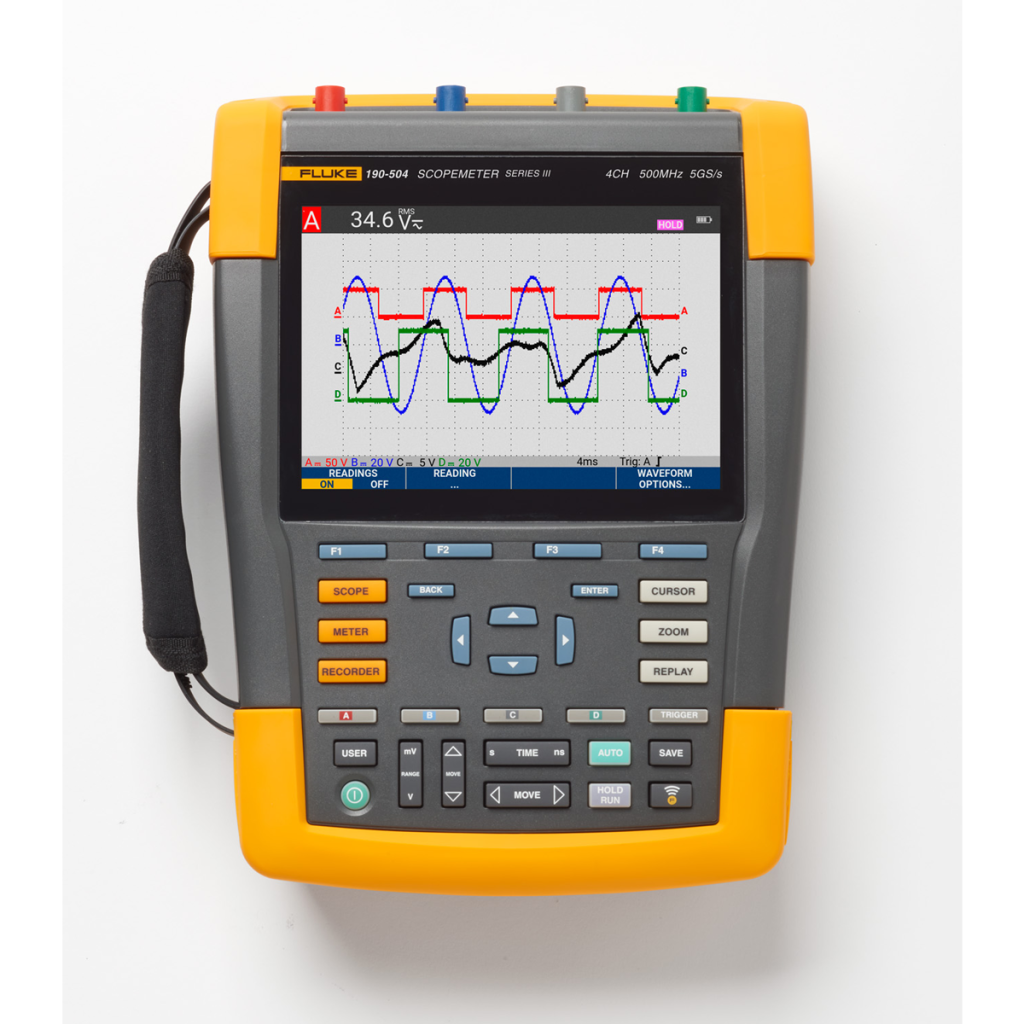
A Fluke ScopeMeter combines oscilloscope functionality with multimeter capabilities in a portable format. This design can help field technicians investigate electrical behavior without carrying several separate instruments. However, the available functions and performance vary by model.
Consider the following diagnostic requirements before comparing products:
For example, a technician diagnosing a machine that stops unexpectedly may need to capture a control signal immediately before shutdown. A basic multimeter reading taken afterward might show a normal value because the fault has already disappeared.
In contrast, a technician who mainly checks steady voltage and resistance may not need advanced waveform analysis every day.
Define your most demanding realistic diagnostic task first. Then use it to identify the minimum capabilities your instrument must provide.
Bandwidth and sampling rate are two important specifications when evaluating a portable oscilloscope. They influence the types of signals the instrument can display and how effectively it captures changes over time.
However, these specifications describe different aspects of performance, so you should not treat them as interchangeable.
Oscilloscope bandwidth describes the frequency at which the instrument’s response falls by a specified amount, commonly 3 dB from its low-frequency response. In practical terms, bandwidth affects how accurately the oscilloscope represents signals containing higher-frequency components.
A model with insufficient bandwidth may display a fast-changing signal with reduced amplitude or distorted detail. Consequently, technicians investigating switching circuits or fast transients should evaluate bandwidth against the signals they expect to encounter.
The required bandwidth depends on the signal’s characteristics and the accuracy needed for the measurement. A high-frequency signal may require substantially different capabilities from a slow industrial control signal.
Sampling rate indicates how frequently the oscilloscope digitizes the incoming signal. A higher sampling rate can provide more time-domain detail, provided the instrument’s other specifications and acquisition settings support the measurement.
Nevertheless, a high sampling rate does not compensate for insufficient analog bandwidth. Both specifications matter, along with record length, acquisition mode, and triggering capabilities.
Before you buy a Fluke ScopeMeter, compare the bandwidth and sampling specifications for the exact models under consideration. Also review how those specifications apply to the intended number of channels and acquisition conditions.
For additional context, read this guide to choosing oscilloscope bandwidth for industrial signals and this explanation of oscilloscope sampling rate and bandwidth.
An oscilloscope’s diagnostic value depends not only on how quickly it samples signals but also on how effectively it captures the event you need to investigate.
For field work, triggering, acquisition options, record length, and channel availability can influence whether you obtain useful evidence from a difficult fault.
Determine how many signals you need to observe simultaneously. A technician investigating a control system may want to compare an input signal with an output signal. Another task may require examining several related electrical signals to establish their timing relationship.
A model with more channels can support more complex comparisons, but it may not be necessary for routine single-signal diagnostics. Also verify whether channel count affects other specifications or available measurement functions.
Triggering allows the oscilloscope to begin or stabilize waveform acquisition around a defined event. Depending on the model, available trigger options may help isolate particular signal conditions or transitions.
Record length determines how much sampled information the instrument can retain for analysis. A longer record can help technicians examine more of an event before and after the trigger, although memory depth, sample rate, and acquisition settings interact.
Consider an intermittent motor-control fault. The technician may need to capture the waveform leading up to a shutdown and inspect the event afterward. In this situation, trigger flexibility and sufficient record length may be more useful than an impressive headline specification alone.
Before choosing a model, ask:
These questions help you compare actual diagnostic capability rather than relying solely on the product’s general description.
A key advantage of a ScopeMeter is its ability to combine waveform analysis with multimeter measurements. This arrangement can reduce the need to switch between separate instruments during field diagnostics.
However, multimeter functions differ across models. Review the specifications instead of assuming that every portable oscilloscope provides the same measurement capabilities.
Depending on the model, relevant functions may include:
Confirm the available functions, measurement ranges, accuracy, and supported accessories for each candidate.
For example, a technician checking a sensor circuit may first measure its DC supply voltage and then inspect the waveform for noise or interruptions. Having both functions available in one instrument can make this workflow more convenient.
Still, integrated functionality does not remove the need for appropriate measurement procedures. Use the correct input, accessory, and operating mode for each test, and observe the instrument’s stated limits.
Also evaluate the interface. Clear menus, readable displays, accessible controls, and practical measurement navigation matter when working in cramped cabinets or poorly lit maintenance areas.
An instrument with advanced functions can become frustrating if technicians struggle to configure it during time-sensitive troubleshooting.
A portable diagnostic instrument must suit both the electrical environment and the physical conditions in which technicians operate. These requirements deserve the same attention as bandwidth or sampling rate.
Check the model’s voltage limits, measurement category ratings, and compatibility with the intended measurement environment. Also verify the ratings of test leads, probes, and other accessories.
Do not assume that a model suitable for one electrical installation is appropriate for every circuit with a similar voltage. Measurement category and transient exposure can influence the required protection level.
For work involving hazardous electrical energy, follow your organization’s safety procedures and use the appropriate protective equipment. Never exceed the instrument’s published limits.
Consider the following factors:
For example, a technician performing maintenance across multiple production lines may value low weight and convenient controls. Someone diagnosing complex power electronics may prioritize measurement performance and specialized accessories.
Balance these considerations against your actual working environment. A feature that rarely contributes to your daily tasks should not outweigh an essential safety or diagnostic requirement.
After defining your requirements, shortlist models that meet the essential technical and safety criteria. Then compare the remaining differences in measurement performance, usability, accessories, and service support.
Avoid selecting a model based only on its series name. Products within a family may differ in bandwidth, channel configuration, measurement functions, memory capabilities, or other specifications.
For each candidate, confirm:
Next, determine whether the quoted configuration includes everything required for your diagnostic workflow. A compatible accessory may be essential even when it does not appear in the standard package.
Also confirm the product’s availability and condition, particularly if you are considering used or refurbished equipment. Request clear information about the included items and any applicable warranty or service limitations.
Technical support deserves attention as well. A supplier should help clarify specifications, accessory compatibility, and documentation when necessary. You can explore the available equipment and resources at TRUEPOINTLAB while assessing your options.
Finally, compare the shortlisted models against your original diagnostic requirements. Select the model that satisfies your essential criteria without paying for capabilities your team does not need.
Identify your diagnostic applications, required bandwidth and sampling rate, channel needs, multimeter functions, safety ratings, portability requirements, and compatible accessories. Compare the specifications of the exact models you are considering.
It serves a different purpose. A ScopeMeter combines oscilloscope waveform analysis with multimeter functionality, making it useful for investigating changing or intermittent electrical signals. A standard multimeter may be sufficient for routine steady-state measurements.
The required bandwidth depends on the frequency content of the signals and the accuracy needed to represent them. Review your application’s signal characteristics and compare them with the instrument’s published bandwidth specifications.
Sampling rate affects how frequently the instrument digitizes a signal, while record length determines how much sampled information it can retain. Both influence waveform analysis, particularly when investigating fast or intermittent events.
Confirm the required probes, test leads, adapters, and other application-specific accessories. Check their compatibility, electrical ratings, and whether the supplier includes them with the selected model.
The right Fluke ScopeMeter should match your real field requirements, from signal capture and measurement performance to safety, portability, and accessory compatibility. A higher specification alone does not guarantee a better fit for every technician.
Start with the faults your team needs to diagnose, establish the essential technical requirements, and compare exact models against those criteria. Then verify the supplied accessories, documentation, and support arrangements before ordering.
Explore TRUEPOINTLAB as you evaluate equipment options for your field measurement workflow. A careful comparison can help you select an instrument that supports practical troubleshooting without adding unnecessary complexity.
TruePointLab.© 2026. All right reserved