Call us now: +1(800) 123 4567
Email: oesus@support.com

A pressure transmitter can report an incorrect reading even when the process appears normal. A pressure gauge may also drift over time, creating uncertainty during maintenance checks. Without a suitable reference instrument, technicians can struggle to determine whether the problem comes from the device under test, the test setup, or the pressure source itself.
A pressure calibrator helps engineers check pressure instruments against a known reference and evaluate whether their readings meet specified tolerances. However, selecting the right model involves more than comparing maximum pressure ratings. Engineers must consider the working range, measurement accuracy, pressure generation method, media compatibility, and the requirements of the instruments they test.
This guide explains how to choose a pressure calibrator for industrial applications, with practical advice on range selection, accuracy, and pump types.
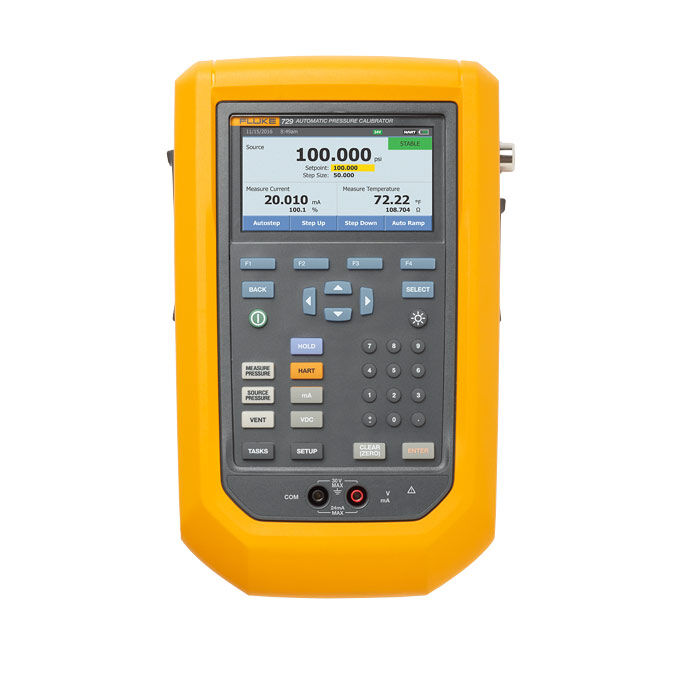
A pressure calibrator is a test instrument used to measure, generate, or compare pressure when checking devices such as pressure gauges, transmitters, switches, and sensors. Depending on its design, it may combine a reference pressure sensor, a pressure source, a digital display, and electrical measurement functions.
Technicians commonly use pressure calibrators during commissioning, preventive maintenance, troubleshooting, and formal calibration procedures. For example, a technician may apply several known pressures to a pressure transmitter and compare the transmitter’s output with the reference value.
Different models serve different purposes. A digital pressure calibrator may measure pressure without generating it, while a complete calibration kit may include a hand pump, hoses, adapters, and a reference instrument.
The best pressure calibrator is the one that matches the required pressure range, uncertainty, and test procedure. A high-pressure model does not automatically provide better results for low-pressure instruments, and a highly accurate reference cannot compensate for leaks or an unsuitable test setup.
Range selection is one of the most important decisions because it affects usability, resolution, and measurement performance.
Start by identifying the minimum and maximum pressures you need to test. Consider the instrument’s calibrated range, normal operating conditions, and the test points required by your procedure.
For example, if a pressure transmitter operates from 0 to 10 bar, a calibrator with a suitable range around that working interval may be more practical than a model designed for hundreds of bar. Conversely, a hydraulic system operating at high pressure requires equipment rated for that application.
When selecting the range, consider:
A calibrator that barely covers the maximum test pressure may leave little flexibility. However, choosing an unnecessarily broad range can reduce the practical resolution available for smaller pressure changes.
Pressure reference type also matters. Gauge pressure measures pressure relative to the surrounding atmosphere. Absolute pressure uses a vacuum as its reference, while differential pressure measures the difference between two pressure points.
These measurements are not interchangeable without accounting for their reference conditions. For instance, a differential-pressure transmitter across a filter may require a low differential-pressure range even though the process line operates at much higher static pressure.
Before buying a calibrator, confirm the pressure reference required by the instruments and ensure that the equipment supports the intended measurement method.
Accuracy determines how closely a measurement approaches the relevant reference value under specified conditions. It is central to calibration because the reference instrument must provide sufficiently reliable results to assess the device under test.
However, accuracy specifications can use different formats, including percentage of full scale, percentage of reading, or a combination of terms. Read the manufacturer’s specification carefully rather than comparing headline numbers alone.
Suppose a reference instrument has an accuracy specification of ±0.1% of full scale over a 10 bar range. The corresponding accuracy limit is ±0.01 bar.
At a test pressure of 1 bar, that absolute limit represents 1% of the test reading. Consequently, a specification based on full scale may be less suitable for demanding low-pressure measurements than the headline percentage initially suggests.
A percentage-of-reading specification behaves differently because the permitted error changes with the measured pressure. Always check the exact specification, including any minimum error limits and operating conditions.
The calibrator must support the uncertainty and tolerance requirements of the calibration procedure. A reference that is too uncertain may not provide enough evidence to determine whether a device meets its specification.
For example, a pressure gauge with a tolerance of ±0.1 bar may require a more accurate reference than a gauge with a tolerance of ±0.5 bar. The appropriate relationship depends on the organization’s calibration policy and uncertainty analysis.
Engineers should also consider factors beyond the accuracy statement:
A suitable reference instrument is necessary, but good measurement practice is equally important. A poorly connected or unstable setup can undermine the value of even a high-performance calibrator.
The pressure source determines how technicians generate and control the pressure applied during testing. The appropriate pump depends on the required pressure range, fluid compatibility, portability, and control precision.
Pneumatic pumps generate pressure using air or another compatible gas. Many technicians use them for low- to medium-pressure applications, including pressure transmitters, gauges, and some differential-pressure instruments.
Their advantages include portability and the ability to avoid introducing liquid into a clean pressure system. Nevertheless, gas compressibility can make pressure stabilization and fine adjustments challenging, particularly when the test setup contains a large volume.
Choose a pneumatic pump when the application requires clean gas pressure, manageable portability, and a pressure range that the pump can generate safely.
Hydraulic pumps generate pressure using a liquid, often for higher-pressure applications. Because liquids compress much less than gases under typical calibration conditions, hydraulic systems can offer controlled pressure generation for suitable equipment.
However, liquid compatibility matters. Residual fluid can contaminate a device that must remain dry, and trapped air can affect the pressure response. Technicians should also confirm that the liquid is compatible with the instrument, seals, and process requirements.
Hydraulic pumps are useful for appropriate high-pressure applications, but they are not automatically the best option for every pressure calibrator.
Manual pumps suit portable maintenance tasks and applications that do not require extensive automation. Automated pressure controllers can offer repeatable pressure steps and reduce the effort needed for complex calibration sequences.
The decision depends on workload. A technician checking a few gauges in the field may prefer a portable manual kit. A laboratory processing many pressure instruments may benefit from automated pressure control and integrated documentation.
Regardless of pump type, verify the maximum working pressure, connection ratings, pressure stability, and manufacturer’s operating instructions before use.
A structured selection process helps maintenance teams avoid choosing equipment based on a single specification.
Create a list of pressure gauges, transmitters, switches, and sensors that require testing. Record their pressure ranges, reference types, connection requirements, accuracy tolerances, and operating environments.
Next, identify the most common tasks. A team that primarily checks low-pressure pneumatic instruments has different needs from one that maintains hydraulic equipment or high-pressure process systems.
A calibrator may meet the required range and accuracy yet remain unsuitable if it cannot connect properly to the instrument.
Check the following before selecting a kit:
If technicians test pressure transmitters with electrical outputs, a combined process calibrator may be useful. However, do not pay for functions that the team does not need unless future work justifies them.
Calibration equipment needs its own maintenance and calibration schedule. Keep records of instrument identification, calibration status, due dates, and any limitations that affect use.
A consistent system helps technicians select suitable references and avoid using instruments with expired or unsuitable calibration status. Teams can also review industrial calibration equipment for plant teams when standardizing equipment across maintenance workflows.
Several selection errors can create unnecessary costs or unreliable measurements.
Choosing range without considering the actual test points can reduce resolution or leave required pressures outside the instrument’s capability. Review the complete working range rather than focusing only on the maximum pressure.
Comparing accuracy specifications without checking their basis can lead to an unsuitable reference. Confirm whether the manufacturer specifies percentage of reading, percentage of full scale, or another accuracy expression.
Selecting the wrong pump type can introduce contamination, make pressure control difficult, or prevent the team from reaching the required pressure safely. Match the pump to the medium, range, and instrument requirements.
Ignoring the connection system can lead to leaks, unstable readings, or incompatible materials. Check every pressure-bearing component, not just the calibrator.
Finally, do not treat every pressure check as a formal calibration. A functional check can confirm that an instrument responds, while calibration requires comparison with a suitable reference under a defined procedure and assessment against specified tolerances.
Choosing a pressure calibrator requires a balanced assessment of pressure range, accuracy, pump type, and application requirements. Start with the instruments your team tests, determine the necessary pressure points and tolerances, and then select a suitable reference and pressure-generation method.
Before making a decision, review connection compatibility, calibration documentation, operating conditions, and the practical needs of your maintenance team. Visit TRUEPOINTLAB to explore industrial measurement and calibration resources that can help inform your equipment selection.
Choose a range that covers all required test points while providing suitable resolution and measurement performance. Consider the instrument’s operating range, pressure reference, and future testing needs.
The required accuracy depends on the tolerance of the instrument under test and the calibration procedure’s uncertainty requirements. Review the full specification, not just the headline percentage.
Pneumatic pumps use gas and often suit portable, clean-pressure applications. Hydraulic pumps use liquid and commonly serve suitable higher-pressure applications. Media compatibility and operating limits determine the appropriate choice.
Yes, if its pressure range, reference type, connections, and measurement functions support both devices. Testing transmitters may also require electrical measurement capability.
The interval depends on usage, stability, environmental conditions, accuracy requirements, and the organization’s quality procedures. Review calibration history and risk when establishing the interval.
TruePointLab.© 2026. All right reserved