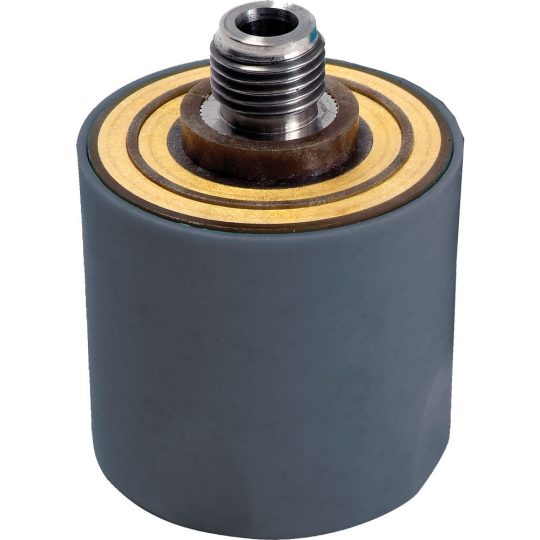
The Fluke Calibration P3211-PSI Deadweight Tester is a reliable primary pressure standard, delivering accurate, stable, and traceable pressure calibration from 10 to 500 PSI (35 bar / 3.5 MPa). With a single piston-cylinder unit, it offers straightforward, precise performance for both laboratory and industrial applications.
This model uses water as the operating medium, ensuring clean, oil-free operation—ideal for calibration environments where contamination from hydraulic fluids is unacceptable. Pressure is generated by loading precision-calibrated masses onto the piston-cylinder assembly, creating inherently accurate and traceable pressure points that meet international metrology standards.
Compact, durable, and highly accurate, the P3211-PSI is perfectly suited for facilities requiring dependable calibration of low- to medium-pressure instruments such as pressure gauges, transmitters, and sensors.
Key features include:
-
Pressure range: 10–500 PSI (approx. 35 bar / 3.5 MPa)
-
Single piston-cylinder unit for precise, repeatable calibration
-
Water-operated, oil-free design for contamination-free use
-
Primary standard accuracy of ±0.015% of reading
-
Rugged design suitable for laboratory and field applications
-
Compatible with interchangeable Fluke mass sets (PSI, bar, MPa, kgf/cm²)
Compatible media: Water and suitable water-based fluids.
Included accessories: Piston-cylinder assembly, calibrated mass set, reservoir, test connections, and operator manual.
Compliance: ISO/IEC 17025 traceable calibration supported; GLP/GMP compatible.
Benefits for lab users: Provides oil-free calibration with high accuracy across low- to medium-pressure ranges, reduces measurement uncertainty, and ensures compliance with international calibration standards.