Call us now: +1(800) 123 4567
Email: oesus@support.com


$2,114.00
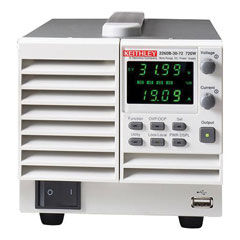
A high-current programmable DC power supply delivering up to 30 V, 72 A, and 720 W with fast transient response and multiple communication interfaces, designed for R&D, production, and automated test environments.
The Keithley 2260B-30-72 Programmable DC Power Supply is a powerful and versatile instrument designed to deliver precise, stable, and flexible DC output for demanding test applications. With a maximum output of 30 V, 72 A, and 720 W, it provides the high current required to test power-hungry devices such as DC-DC converters, automotive electronics, LED arrays, and battery packs.
The 2260B-30-72 combines low output noise with fast transient response, ensuring stable operation for sensitive devices while also handling dynamic load changes effectively. Its programmable output sequencing and list mode make it possible to simulate real-world power conditions. The large color display and intuitive front-panel interface simplify operation, while USB, LAN, and optional GPIB connectivity allow seamless integration into automated test systems.
Key Features:
Programmable DC output up to 30 V, 72 A, 720 W
High current capacity for power electronics and battery testing
Low output ripple and noise for precision testing
Fast transient response for dynamic load conditions
Programmable sequencing and list mode for real-world simulation
Interfaces: USB, LAN, and optional GPIB
Compatible Applications/Materials:
Automotive electronics and LED testing
Battery charging and simulation
Power supply and DC-DC converter validation
R&D, quality assurance, and automated production testing
Included Accessories:
Power cord, user manual, safety documentation, and calibration certificate.
Compliance & Standards:
Meets CE, UL, and ISO/IEC standards; suitable for GLP-compliant laboratories and production environments.
Benefits for Lab Users:
Delivers high-current output with precision and stability
Enables realistic power condition simulation with programmable features
Reduces test time with automation-ready interfaces
Provides reliable, repeatable performance for both R&D and production