Call us now: +1(800) 123 4567
Email: oesus@support.com

Industrial technicians often need to diagnose electrical problems while equipment remains installed in a production line, control cabinet, or motor system. A conventional multimeter can measure voltage and resistance, but it may not reveal brief signal interruptions, waveform distortion, or electrical events that occur immediately before a machine stops.
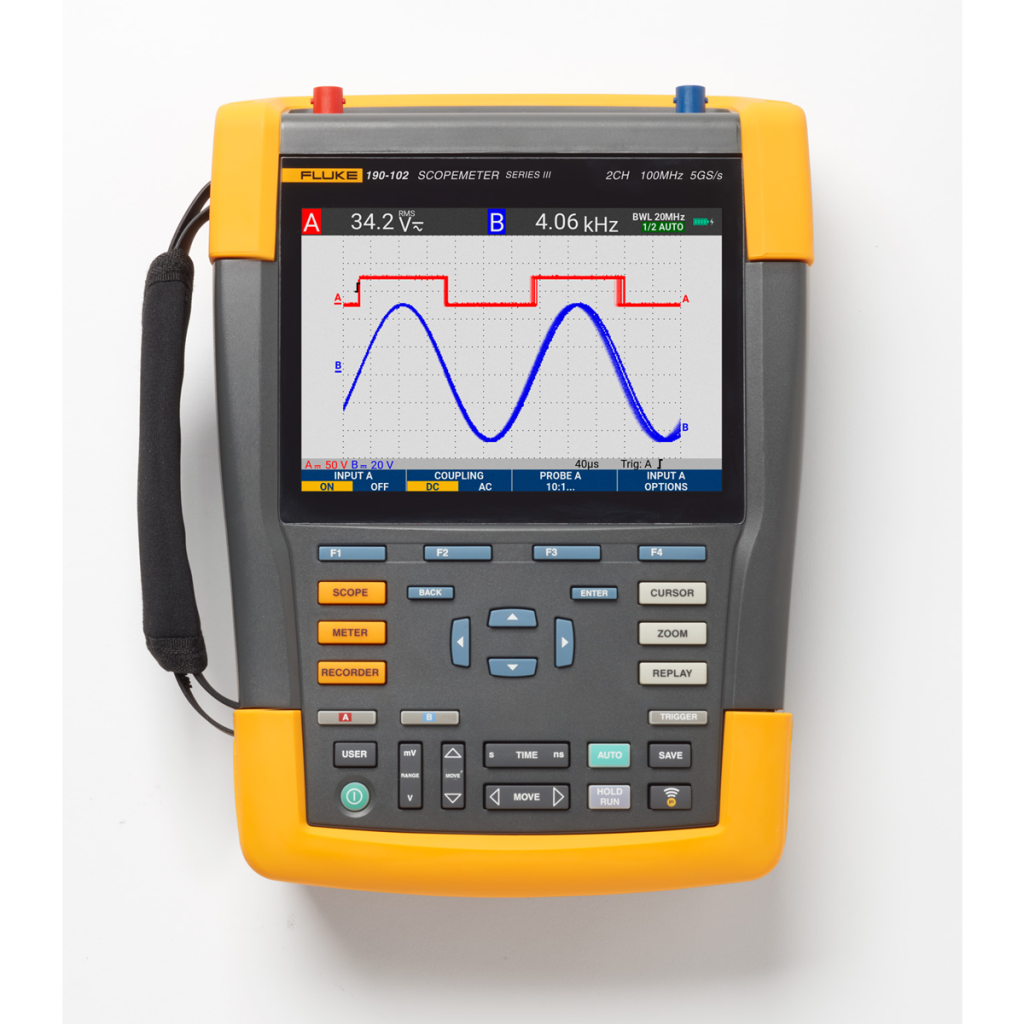
A portable oscilloscope can help investigate these problems, and a Fluke ScopeMeter combines oscilloscope capabilities with multimeter functions in a field-oriented instrument. However, the most useful features depend on the electrical signals, safety requirements, and troubleshooting tasks involved.
If you plan to buy a Fluke ScopeMeter for industrial field testing, understanding its key features can help you choose a model that suits your work without overlooking important limitations. This guide examines waveform capture, measurement functions, triggering, safety, portability, and data handling so you can compare models more effectively.
The defining feature of a ScopeMeter is its ability to display how an electrical signal changes over time. Instead of relying only on a numerical reading, technicians can inspect a waveform to identify irregular behavior that may explain an equipment fault.
This capability is useful when diagnosing industrial automation systems, motor drives, electronic controls, and sensor circuits.
Consider a machine that stops unexpectedly several times during a shift. When a technician measures its control voltage after the shutdown, the reading may appear normal. The original fault could have involved a brief interruption that has already disappeared.
An oscilloscope helps the technician investigate the signal’s behavior rather than relying solely on a reading taken at one moment.
Useful waveform analysis features may include:
The exact feature set varies by model. Therefore, review the manufacturer’s specifications before assuming that a particular acquisition or analysis function is available.
For industrial field testing, prioritize the features that help you identify your most common faults. Advanced analysis capabilities are valuable when your application requires them, but they should not replace basic requirements such as suitable measurement performance and electrical safety.
Three important specifications influence how a portable oscilloscope captures and represents electrical signals: bandwidth, sampling rate, and record length. Although they work together, each describes a different aspect of the measurement process.
Oscilloscope bandwidth describes the frequency at which the instrument’s response falls to a specified level, commonly 3 dB below its low-frequency response. Insufficient bandwidth can reduce the displayed amplitude of fast signals and obscure important waveform details.
For example, a technician investigating switching behavior in power electronics may need more bandwidth than someone checking a slowly changing process-control signal.
The appropriate bandwidth depends on the signal’s frequency content and the accuracy required for the measurement. A higher specification is not automatically necessary for every industrial application.
Sampling rate indicates how frequently the oscilloscope digitizes an input signal. A higher rate can provide more time-domain detail, although the result also depends on analog bandwidth, acquisition settings, and other instrument characteristics.
Record length determines how much sampled information the instrument can retain for examination. A longer record may help technicians investigate an event before and after a trigger, but memory depth and sampling rate interact.
When comparing models, check all three specifications together. Do not select an instrument solely because it advertises a high sampling rate.
For a more detailed explanation, read TRUEPOINTLAB’s guides to oscilloscope bandwidth for industrial signals and sampling rate versus bandwidth.
Industrial faults do not always occur at convenient times. A control signal may drop for milliseconds, a relay may behave inconsistently, or an electrical disturbance may appear only when a motor starts.
In these situations, the instrument needs more than adequate bandwidth. It also needs suitable acquisition and triggering capabilities.
A trigger establishes a condition that helps the oscilloscope acquire or display a waveform around a particular event. Depending on the model, trigger options may support specific signal levels, transitions, or other conditions.
For example, a technician investigating a machine shutdown may configure a trigger around a control signal’s transition. The resulting waveform can help show whether the signal changed before the equipment stopped.
When comparing ScopeMeter models, consider:
Do not assume that every model offers identical triggering or recording capabilities. Confirm the exact functions in the product documentation.
It is also important to distinguish capturing an event from diagnosing its cause. A waveform may reveal when a signal changes, but technicians still need to interpret the evidence alongside circuit diagrams, equipment operating conditions, and other measurements.
For a practical discussion of this workflow, see how to capture intermittent electrical faults with a Fluke oscilloscope.
A ScopeMeter can reduce the need to switch between separate instruments because it combines waveform analysis with supported multimeter functions. This can be especially useful when technicians move between several diagnostic tasks in a single maintenance visit.
However, integrated measurement functions vary across models, so check the exact capabilities you need.
Depending on the model, available functions may include:
Suppose a technician is investigating an unstable sensor signal. They may first check the sensor’s supply voltage, then inspect the waveform for noise or brief interruptions. Combining these tasks in one instrument can simplify the workflow.
Similarly, when troubleshooting industrial controls, technicians may need to compare a steady voltage reading with a signal’s behavior over time.
Before purchasing, confirm measurement ranges, accuracy specifications, input limitations, and the required accessories. Also check whether the instrument supports the specific measurement modes your procedures require.
A product’s general description should not replace a review of its technical manual. If a task requires a specialized current measurement method or a particular electrical input configuration, verify that the selected model supports it.
A portable diagnostic instrument must suit the electrical environment where technicians intend to use it. Safety ratings should therefore be a selection requirement, not an optional feature considered after the purchase.
Check the ScopeMeter’s voltage limits, measurement category ratings, and other relevant safety specifications. Then verify that the probes, test leads, and accessories meet the requirements of the intended application.
A voltage rating alone does not establish suitability for every circuit. Measurement category and potential transient exposure also influence the required protection level.
For example, troubleshooting a signal inside a control circuit can involve different hazards from measurements at a power distribution point. Select equipment based on the actual measurement location and follow your organization’s electrical safety procedures.
Field testing also places demands on the instrument’s physical design. Review features such as:
For example, a technician who travels between production lines may prioritize convenient handling and clear controls. A specialist working with power electronics may place greater emphasis on waveform capabilities and suitable accessories.
Choose the combination that fits your environment. Never trade away essential electrical safety requirements to gain a more convenient form factor.
Capturing a waveform is only part of a diagnostic workflow. Technicians may also need to save evidence, compare measurements, prepare maintenance reports, or share findings with engineering teams.
Consequently, data handling and connectivity deserve attention when comparing ScopeMeter models.
Depending on the model, available options may include internal waveform storage, USB connectivity, communication software, or methods for transferring screenshots and measurement records.
Before purchasing, confirm which functions the exact model supports. Do not assume that a USB connection guarantees compatibility with every computer, software package, or data format.
Ask these questions:
A maintenance team that documents recurring faults may benefit from straightforward waveform storage and transfer. A technician who performs quick checks without formal reporting may have simpler requirements.
Before placing an order, confirm the exact model designation, bandwidth, sampling rate, acquisition capabilities, channel configuration, multimeter functions, safety ratings, accessories, and data-handling options.
Also review the warranty, technical documentation, and available support arrangements. If the supplier cannot confirm an important feature, request clarification from the manufacturer rather than relying on an assumption.
For a broader purchasing framework, read this guide to comparing Fluke ScopeMeter models for field diagnostics.
Finally, compare each candidate against your actual diagnostic tasks. The most suitable model is the one that meets your essential requirements, supports your team’s workflow, and provides the necessary safety and measurement capabilities.
Prioritize suitable bandwidth, sampling rate, triggering, waveform capture, required multimeter functions, safety ratings, and compatible accessories. Data handling and portability also matter when technicians work across multiple locations.
It can help capture and analyze intermittent signal behavior when the model provides suitable acquisition, triggering, and recording capabilities. Successful diagnosis also depends on configuring the instrument appropriately for the fault.
Bandwidth affects how the instrument responds to different signal frequencies, while sampling rate determines how frequently it digitizes the signal. Both influence waveform representation and should match the intended measurement task.
Yes. It can simplify workflows that require both numerical measurements and waveform analysis. However, check the exact model’s measurement functions, ranges, accuracy, and accessory requirements.
Confirm the model’s specifications, safety ratings, supported functions, probes and accessories, data-transfer capabilities, documentation, and warranty arrangements. Match these details to your actual field-testing requirements.
The most useful ScopeMeter features are those that help technicians investigate actual industrial faults safely and efficiently. Waveform capture, suitable bandwidth, triggering, integrated measurement functions, and practical data handling can all contribute to a more effective diagnostic workflow.
Before choosing a model, document your testing requirements and compare the exact specifications rather than relying on product family names or headline features. Verify accessories and safety ratings as well, because the complete measurement setup matters as much as the instrument itself.
Explore the available equipment and technical resources at TRUEPOINTLAB as you evaluate options for your application. A focused feature comparison can help you choose a portable diagnostic instrument that fits your team’s day-to-day work.
TruePointLab.© 2026. All right reserved